The histories of Black students, faculty, and staff have too often remained hidden at law schools across the United States. And for more than a century, that was the case at Colorado Law. However, in 2024, work began to restore these individuals to the institutional narrative. The first product of this research was a news article written primarily for law school audiences. Research into the history of Black students, faculty, and staff expanded, leading to additional works and media coverage, including an alumni magazine article, an article published by The Conversation describing the research process, and a Colorado Public Radio segment and accompanying digital article.
Included in this repository are information and documents surrounding the Black students who historically attended the University of Colorado Law School. The foundation of this digital project are the artifacts collected by librarian Rebecca Ciota as they researched these individuals. We thank Ciota for their initial donation of these digital artifacts and biographies.
Research into the history of Colorado Law's Black students is ongoing. If you have a biography or story that you would like included in this repository, please contact Rebecca Ciota.
-
Franklin LaVeale Anderson (ex 1899)
Rebecca Ciota
Only four years after the University of Colorado Law School’s 1892 opening, Franklin LaVeale Anderson (ex 1899) enrolled at the law school in 1896. He is believed to be the first Black student to enroll at the University of Colorado Boulder and is the University of Colorado Law School’s first Black student.
Anderson was born a free person in St. Louis, Missouri, in 1859. During his early childhood, slavery was legal in Missouri. Slave-holding states in the Antebellum United States forbid the formal education of Black persons.11 However, records indicate that Anderson received some education in Missouri, while also taking up work as a barber, before he moved to Minneapolis in 1885 at the age of 26. There, he continued his barbering and schooling, graduating high school in 1886. While living in Minneapolis, he met and married his wife Ione Arella Williams.
The couple moved to Boulder in early 1892. They purchased multiple lots in town, living near 20th and Pine. Anderson established his barbershop on the corner of 12th (now Broadway) and Pearl Street.
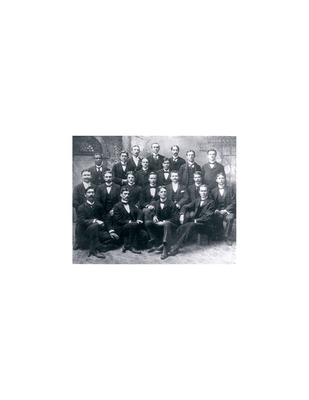
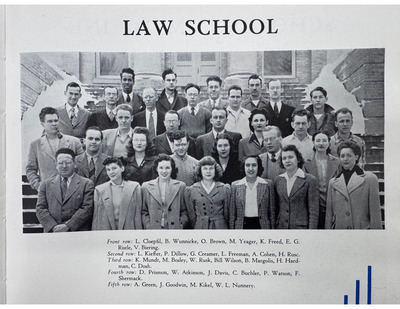
In 1896, at the age of 37, Anderson enrolled at the University of Colorado Law School, using earnings from his barbershop to pay for tuition and supplies. He attended until 1899 and is included in the 1899 class photo. However, the law school faculty did not include Anderson in their list of students who should be conferred the Bachelor of Laws degree in May 1899.
Anderson attempted the bar exam in 1899, but unfortunately did not pass. Around 1900, Anderson and his wife sold their properties and left Boulder, settling in Fort Morgan, Colorado for some time. Anderson passed in 1918 from kidney failure.
-
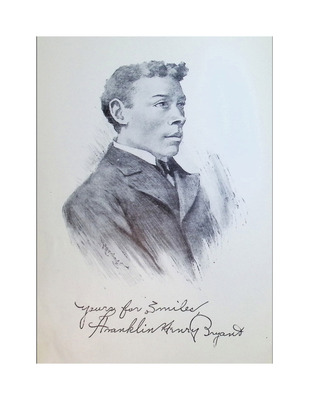
Franklin Henry Bryant (1907)
Rebecca Ciota
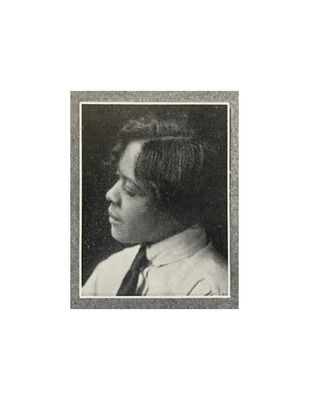
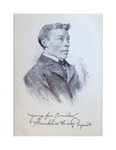
Born in 1877 and troubled from a young age by lung problems,19 Franklin Henry Bryant (1907) dedicated himself to his education. In 1898, he joined the Seventh Day Adventist Church, where he served as a stenographer for the son of the founders of the Seventh Day Adventists, J. Edson White.
Bryant traveled across the country with the Adventists. After suffering an injury to or illness in his face, he traveled to Battle Creek, Michigan, for treatment, where the Adventist Sanitarium workers received him poorly. J. Edson White and his brother W.C. White interceded on Bryant’s behalf, and Bryant moved to Nashville to receive medical training. Bryant published a collection of poems titled Black Smiles (1903) to help pay for medical school. He briefly attended Northwestern University’s Medical School in Chicago before moving to Denver in 1905 to be closer to his father.
In Denver, he lectured and performed poetry; and he joined the socialist and labor movements. He first enrolled at the University of Denver’s Law School before transferring to the University of Colorado Law School in 1906, graduating only a year later in 1907.
Bryant became the third Black attorney to pass the Colorado Bar Exam and went on to establish a firm in Denver. Five months after passing the bar, he was the first and youngest Black attorney to argue a case before the Colorado Supreme Court (55 Colo. 523, 139 P. 1099) - which he posthumously won four years after his untimely death from pneumonia in 1909.
-

Ailey William Lewis (1911)
Rebecca Ciota
Born circa 1880 to Joseph H. Lewis and Cordelia Bradley Lewis, Ailey William Lewis (1911) spent his formative years in the boroughs outside of Pittsburgh, Pennsylvania. He attended high school in Carnegie, Pennsylvania. He married his wife, Mary L. Simmons, in 1902. At some point, Lewis sought out a postsecondary education at Muskingum College in New Concord, Ohio. Then, he and his wife moved to Denver sometime between 1902 and 1907, when he published a poem entitled “A Summer Day in San Lus [sic] Valley” in The Statesman, a Black newspaper from Denver.
He likely entered law school in 1909, during a time when Colorado was one of the most prestigious programs at the law school. He graduated from law school in 1911 and took the bar in Denver. He seemed to have passed the bar as he began advertising his practice in local Black newspapers. His Denver practice was successful for five years when “he had to abandon his practice” circa 1916 because of health issues.
Sometime between closing his Denver practice and 1919, Lewis and his wife moved from Denver to Omaha, Nebraska. There, Lewis was an active member of the Black community: he participated regularly in the local NAACP chapter; gave lectures; and wrote for The Monitor, a weekly Black newspaper. He was admitted into the Nebraska Bar in 1919 and, in 1921, opened a law office on the south side of Omaha. Lewis maintained connections in Omaha, even after he moved northward to Sioux City, Iowa.
In 1925, Lewis married Betty Pride Jackson of Sergeant Bluff, Iowa. In 1940, the U.S. Census showed that Lewis and his wife Betty were living in Sioux City, Iowa. Lewis was working as a janitor. He died nine years later in 1949. Research into Lewis’s life is ongoing.
-
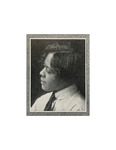
Adele "Della" Parker (ex 1914)
Rebecca Ciota
Adele “Della” Parker (ex 1914) was born in Rolla, Missouri, to formerly enslaved parents, John Henry and Sedonia (née Blackwell) Parker, circa 1883. During her teenage years, Parker worked as a servant in order to support her younger siblings’ education.
Around the turn of the century, Parker left Missouri and arrived in Denver, where she began to focus on her own education. She enrolled in the University of Denver’s (DU) Preparatory School and joined the school’s Adelphian Literary Society, which focused on recitation, writing, musical performance, and debates. She graduated in 1906 and enrolled in DU’s Liberal Arts program, where she studied for one year.
Parker applied to the University of Colorado Law School in 1911 and found herself a bit of a local celebrity when the local newspapers picked up her story. Fortunately, the press seemed favorable, claiming that Parker made “the superiority of masculinity...no longer self-evident" and that she had a “bright future.” She was a dedicated student and skilled debater while attending the law school.
Unfortunately, Parker did not finish her law degree as she needed to return home to care for a sick relative. She remained in Missouri, earning a teaching certificate and teaching in the Lincoln School, one of the Black schools in the St. Louis suburbs. By 1930, she owned her own home. Parker retired in the early 1950s and passed away in 1963.
-

Arthur Erthal Green (1945)
Rebecca Ciota
Originally from LaJunta, Colorado, Arthur Erthal Green (Law 1945) enlisted in the military in 1942. He was promoted to the level of sergeant while stationed in California. There, he met his future wife, Gwendolyn, at a social event. The couple married shortly after in Colorado. Boulder was unwelcoming to Green and his family due to their race; for example, Boulder barbershops refused to cut Green’s hair. Arthur and Gwendolyn Green started an NCAACP chapter in Boulder. In 1945, Green - who believed he was only the second Black student to attend the law school - graduated from the University of Colorado Law School.
The Greens moved to Oakland, California shortly after his law school graduation. Arthur worked for Golden State Insurance while supporting Gwendolyn in her civil rights work. After a short time in San Diego, the couple settled in Los Angeles, where they co-founded the New Frontier Democratic Club, which is currently the largest Democratic Club in the state. Gwendolyn went on to be a significant civil rights and workers’ rights activist nationally and regionally. She credited her success, in part, to having “a husband [Arthur Green] that was willing to work together and we were involved.”
-
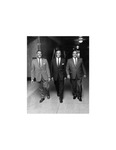
Isaac Edward Moore, Jr. (1949)
Rebecca Ciota
Isaac Edward Moore, Jr. (1949) Was born in Colorado Springs on March 20, 1924, to Isaac Edward Moore, Sr. and Kathryn C. Brown, a medical doctor and a schoolteacher, respectively. Moore graduated from Thomas Jefferson High School in Los Angeles and then completed his undergraduate courses at the University of Southern California.
Inspired by Thurgood Marshall, he applied to and was accepted at the University of Colorado Law School. The university and law school subjected Moore to severe injustices. The law school faculty all but ignored him. The White students refused to share housing with their Black classmates, and the university sided with them, asking Black and other marginalized students to "live with their people.” Effectively forced off campus by the university and faced with a lack of housing options near the law school due to housing discrimination, Moore slept in a coal shed for shelter while attending law school.
Moore graduated in June 1949 and was admitted to practice in September of that year. He co-founded the firm Flanigan & Moore with another Black attorney, James C. Flanigan, which brought both lawyers success in and out of court. In 1951, he married Dorothy Elizabeth Williams of Phoenix, Arizona, and the couple made their home in the historically Black Five Points neighborhood in Denver. Throughout the early 1950s, Moore remained active within the Denver community, including participating in The Top Hatters Social Club and serving on the board of a savings firm.
In 1956, Moore decided to extend his service to the community by running for the Colorado State House of Representatives. He served in the Colorado House of Representatives from 1957 – 1960 and then 1964 – 1966. He co-sponsored some of the strongest civil rights laws in the country at the time, including fair housing, open records, fair employment, prison work release, interracial marriage, and the right to counsel (before the federal Miranda decision).
He retired from his legal practice in 1998 and moved to Memphis, Tennessee, with his second wife Alfreda Ingram Moore. He passed away on October 16, 2003.
-
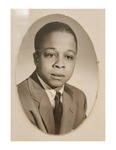
Clarence Blair (1956)
Rebecca Ciota
Born in Tyler, Texas on October 2, 1929, to farmers Samuel and Florence Blair, Clarence Edward Blair (1956) grew up as the beloved eldest son and grandson. During his teenage years, Clarence Blair moved – along with his parents, two sisters, and brother – to Denver.
Blair graduated from Manual High School in Denver and then attended the University of Colorado Boulder, where he earned his bachelor’s and master's degrees. He then attended the University of Colorado Denver before returning to his alma mater to earn his law degree in 1956. He passed the Colorado bar exam the same year.
Blair then moved to California and passed the California bar exam. He served as the Compton City Attorney in Compton, California. In the mid-1980s, he switched to specializing in workers’ compensation, ensuring injured employees received the best outcomes. Additionally, Blair participated in pro bono work in this area.
He was well-known in both California and Colorado for his “magnetic” personality and signature sheet cakes and barbecues. He passed away on October 22, 2024.